SCIGMA
Stability Computations and Interactive Graphics for invariant Manifold Analysis
Computational Dynamics Software (1987 - ...)
About SCIGMA
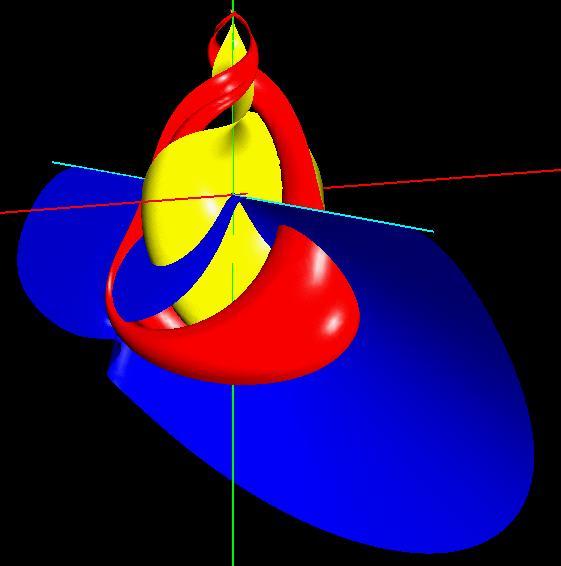
SCIGMA was pioneering software for the interactive visualization and computation of invariant manifolds in dynamical systems. Developed at Princeton University and the University of Minnesota's Institute for Mathematics and its Applications (IMA) in the 1990s, it enabled researchers to explore complex dynamical behaviors through real-time 3D visualization.
Key Features
- • 1D and 2D manifold computation
- • Interactive 3D visualization
- • Real-time parameter exploration
- • Bifurcation analysis tools
- • SGI workstation optimized
Applications
- • Chemical reaction dynamics
- • Fluid dynamics
- • Pattern formation
- • Chaos theory research
- • Educational demonstrations
Legacy & Impact
SCIGMA represented an early vision of what computational science could become: interactive, visual, and accessible. While the SGI workstations it ran on are now museum pieces, the ideas it embodied—that complex mathematics could be made tangible through visualization, that computation could democratize research—remain as relevant as ever.
"The construction of software to be used by scientists and mathematicians alike in the study of phase-, parameter-, and physical-space of dynamical systems with the hopes of creating a means by which one can perform robust numerical experiments."— Original SCIGMA vision statement
Development Team
Original Development
- • I.G. Kevrekidis (Princeton)
- • M.S. Jolly (Indiana University)
- • M.A. Taylor (Princeton)
- • M.E. Johnson (Princeton/IMA)
- • Robert Hölzel
Key References
- • AIChE Annual Meeting (1987)
- • Numerical Algorithms (1997)
- • IMA Research Reports
- • Princeton PhD Theses
- • Research Papers & Publications